EN
EN


The Safety Features That Do Not Appear in Instagram Photos
Marketing images show a car rooftop tent deployed on a clifftop at sunset. What the photo does not show: the ladder locking pins that prevent collapse under asymmetric loading, the gas strut damper that stops the shell from slamming shut in a gust, and the mounting bolts torqued to 45 foot-pounds with thread-locking compound reapplied at 500-mile intervals.
Safety in a rooftop tent is not a single feature — it is a set of interdependent mechanisms that fail sequentially when one component is neglected. Understanding that sequence is what separates a procurement specification from a wish list.
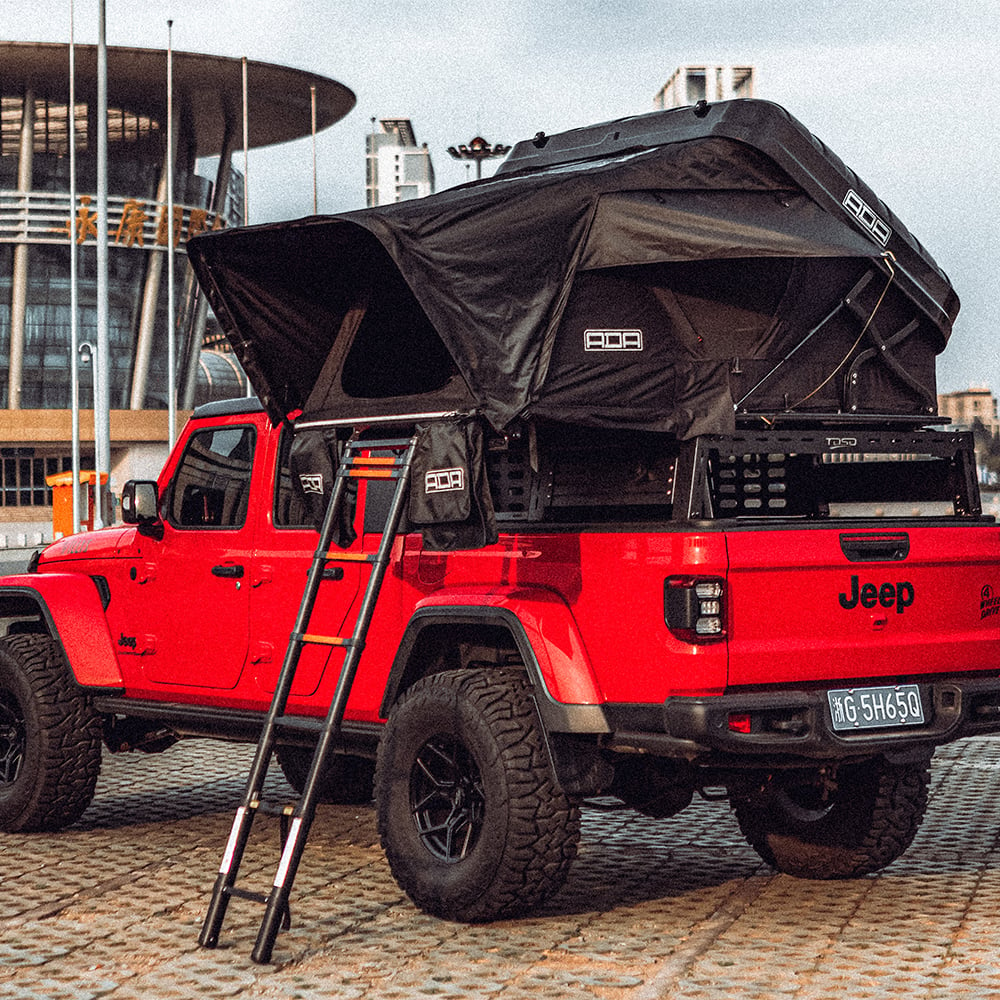
A car rooftop tent ladder that relies on friction alone to hold each rung at its extended position is unsafe by design. Aluminum telescoping ladders with spring-loaded locking pins at each rung joint provide positive mechanical engagement — the pin must physically shear for the rung to collapse, which requires a force exceeding 600 pounds per pin in quality hardened-steel designs. Friction-fit ladders can slip under the dynamic loading of a person shifting weight mid-climb, collapsing one or more rungs without warning.
The locking pin diameter matters. Pins under 6mm in diameter are susceptible to bending under repeated asymmetric loading — a person climbing with one foot favoring the left or right edge of the rung creates a twisting moment that 8mm pins resist and 5mm pins do not.
A ladder set at an angle steeper than 75 degrees from horizontal places the climber's center of gravity behind their feet, increasing the risk of backward tipping. A car rooftop tent ladder set shallower than 60 degrees extends the base too far from the vehicle, creating a trip hazard around the camp and reducing the ladder's effective load capacity because the bending moment on each rung increases with angle. The functional range is 65-72 degrees, achieved by adjusting the ladder's telescoping length — not by moving the base closer to or farther from the vehicle.
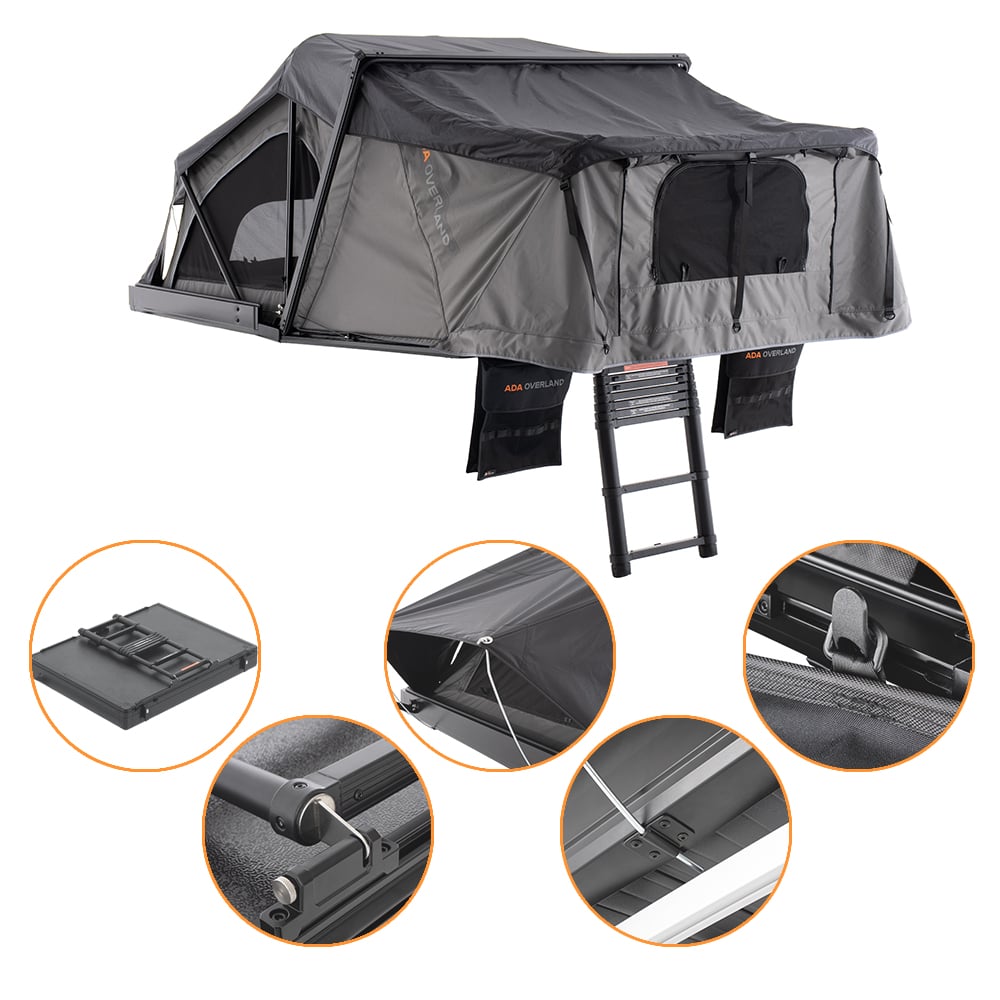
Rubber feet with a 2-inch diameter or larger contact patch prevent the ladder from sinking into soft ground. Feet smaller than 1.5 inches punch through grass and loose soil under body weight, shifting the ladder angle unpredictably during descent.
A roof rack rated for 165 pounds dynamic load supports a 130-pound car rooftop tent with 35 pounds of margin — enough for highway driving but marginal on corrugated terrain where shock loads momentarily double the effective weight. The dynamic rating is tested on smooth pavement. Off-road use demands a 50% safety margin above the combined tent and rack weight. A 130-pound tent on a rack rated for 200+ pounds dynamic load provides that margin.
The static load — parked, occupants inside — is a separate calculation. A tent rated for 700 pounds static load with two 200-pound occupants and 100 pounds of gear runs at 71% of capacity. That is a comfortable margin. The same tent with four occupants and gear approaches or exceeds the rating, and the failure mode — a mounting foot tearing through the tent floor at a bolt hole — is catastrophic.
The four to six bolts connecting a car rooftop tent to the roof rack crossbars are the single-point failure path for the entire system. Grade 8.8 metric bolts (equivalent to Grade 5 SAE) provide a tensile strength of 120,000 PSI minimum. Grade 4.6 bolts — common on budget mounting kits — provide roughly half that strength and are unsuited for off-road vibration environments where cyclic loading causes fatigue failure at stress levels well below the bolt's static rating.
Torque specifications are not suggestions. Under-torqued bolts loosen under vibration. Over-torqued bolts stretch past their elastic limit and snap under shock load. The correct torque for an M8 Grade 8.8 bolt with thread-locking compound is 20-25 foot-pounds; for M10, 35-45 foot-pounds. A torque wrench is not an optional tool for rooftop tent installation.
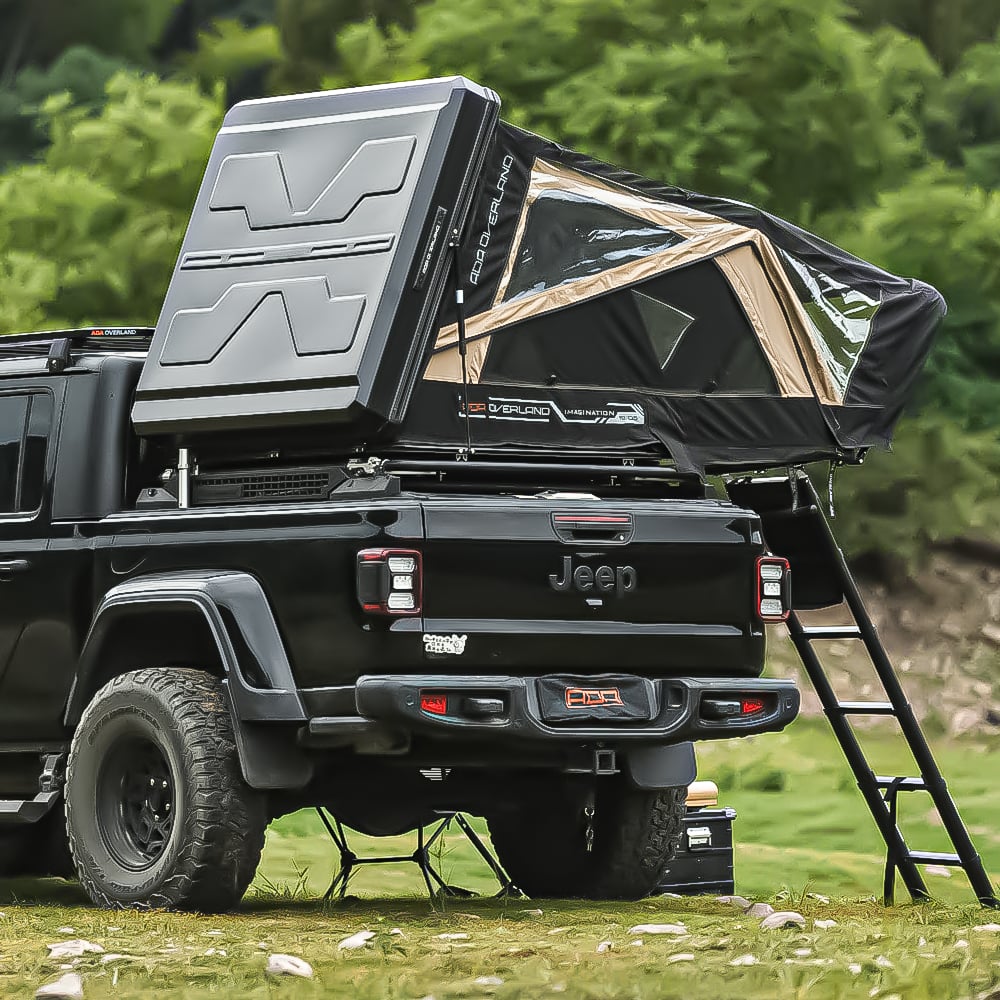
A hard shell car rooftop tent opened on a ridgeline in 25 mph wind faces a real risk of the shell slamming shut. Gas struts with integrated dampers — a hydraulic resistance circuit inside the strut body — slow the closing speed to a controlled rate regardless of external force. Undamped struts allow the shell to close at whatever speed the wind dictates, and a closing hard shell generates enough force at the leading edge to break fingers, damage the shell rim, or shear the mounting bolts that hold the tent to the rack.
Even with damped struts, a car rooftop tent deployed in sustained high wind needs a secondary retention mechanism. Adjustable webbing straps clipped between the shell edge and the roof rack provide a mechanical stop that prevents the shell from closing beyond a preset angle. Without secondary retention, a strut failure in wind allows the shell to close completely, potentially trapping occupants inside a collapsed tent.
An outdoor equipment rental company in British Columbia conducted a season-end safety audit on its fleet of 30 car rooftop tent units after two ladder-related incidents resulted in minor injuries. The audit identified three systemic issues: friction-fit ladders on 18 units had developed sufficient rung wear to slip under loads under 150 pounds; mounting bolts on 12 units had loosened beyond 50% of specified torque within 1,000 miles of off-road use; and gas struts on seven units showed damping degradation — the shells closed in under two seconds from full open, compared to four seconds when new.
The company replaced all friction-fit ladders with locking-pin models, instituted a 500-mile bolt torque check procedure, and added secondary retention straps to all hard shell units. The following season recorded zero ladder incidents and zero mounting failures across roughly 800 rental nights.

Ladder Load Test. With the tent mounted, apply 300 pounds of static load to the center of the middle rung for 60 seconds. Measure rung deflection — more than 5mm of permanent set after load removal indicates material yielding that predicts fatigue failure. Cycle each locking pin 20 times and verify positive engagement with an audible click on every cycle.
Mounting Bolt Torque Verification. After 100 miles of mixed-surface driving, re-torque all mounting bolts. Any bolt requiring more than 90 degrees of rotation to reach specification was inadequately torqued initially. Mark each bolt head with a paint pen after torque verification — a shifted paint mark during subsequent inspections provides instant visual confirmation of bolt loosening.
Strut Damping Test. Open the car rooftop tent shell fully and release it from a 12-inch partial-close position. Time the closing duration from release to full close. A closing time under three seconds indicates degraded damping that requires strut replacement before the next deployment.
The ladder locking mechanism is the component most directly linked to injury prevention. A car rooftop tent ladder must use spring-loaded locking pins at each rung joint — not friction-fit connections — to prevent rung collapse under dynamic climbing loads.
Check car rooftop tent mounting bolt torque every 500 miles of off-road driving. Corrugated terrain loosens fasteners predictably. Re-apply thread-locking compound at 2,000-mile intervals or after any water crossing that submerges the mounting hardware.
A car rooftop tent with damped gas struts and secondary retention straps can remain deployed in sustained 25-30 mph winds. Above 35 mph, the shell should be closed regardless of retention systems. Wind gust forecasts exceeding 40 mph demand closing the tent before the storm arrives.
A quality car rooftop tent ladder with 8mm locking pins supports 300-400 pounds static load. The dynamic load during climbing — roughly 1.5 times body weight due to momentum — reduces the safe user weight to 200-265 pounds for a single occupant on the ladder at one time.
Hard shell car rooftop tent designs with damped gas struts and secondary retention straps handle wind more predictably than soft shell designs. The rigid shell does not flap or deform under gust loading, eliminating the fabric fatigue failure mode that soft shells experience in sustained wind.
Grade 8.8 metric (Grade 5 SAE) bolts with nylon-insert lock nuts or thread-locking compound are the minimum specification for car rooftop tent mounting. Stainless steel bolts in marine environments prevent corrosion but have lower tensile strength — upsize by one diameter compared to the carbon-steel specification.
 Hot News
2026-09-15
2026-09-13
2026-09-06
2026-09-01
2026-08-24
2026-08-21

Zhejiang Ada Outdoor Products Co.,Ltd. provides premium rooftop tents and outdoor camping gear for global B2B partners. 8+ years, 60+ patents, strict QC. Trusted by international brands. Request OEM quote today.